 Gym Wigas
How to build an exercise habit.
Motivation gets you to the gym for a week. What gets you there for six months is a system: something small, at the same time, that shows, and that someone else can see. Here's how to set one up, based on what the research says and with no miracle promises.

Why motivation isn't enough
Most of us start the same way: on a Monday, raring to go, with a five-days-a-week plan. By week three something gets in the way (work, the rain, plain laziness) and the whole plan falls apart.
That's not a character flaw. The plan relied on you being in the mood, and the mood comes and goes. A habit is the opposite: something you do even when you can't be bothered, because you've stopped deciding it each time.
The good news is you can build that. And you build it by repeating it in the same context, not through sheer willpower.
How long it takes to become a habit
The famous 21 days doesn't come from any study of habits. In the most cited one, a team at University College London followed 96 people who repeated the same action every day for 12 weeks. The time it took to become automatic ranged from 18 to 254 days, depending on the person and the action.
Two things from that study matter more than the number. One: what made the action automatic was repeating it in the same context every time (after breakfast, straight after work). Two: missing a single day didn't affect the process.
So don't measure yourself against anyone else's calendar, and don't bin the whole thing over one bad day.
Seven things that actually work
Start ridiculously small
Two days a week, twenty minutes. Your first goal is turning up, not performing. There's plenty of time to step it up later.
Give it a day, a time and a place
“I'm going to start working out” isn't a plan. “Tuesdays and Thursdays, straight after work, at the gym round the corner” is. Deciding in advance saves you arguing with yourself every time.
Cut out the faff
Kit laid out the night before, a gym that's on your way, the workout already picked. Every step you remove is one less excuse.
Make progress visible
Your body takes weeks to change; your consistency doesn't. Keep a count you can see: a streak, a calendar, a character that levels up.
Let someone else know
Training with mates, or at least having them see whether you went, changes everything. Letting yourself down is easy; letting the group down, not so much.
Have a plan for the bad day
It'll rain, you'll finish late, you won't fancy it. Decide your minimum version now: ten minutes at home counts. The rule: never miss twice in a row.
Reward yourself today
The payoff from exercise takes months to arrive, and the sofa pays out now. Pair your session with something you enjoy straight away: your music, a game, beating someone.

Why playing helps
A game is good at exactly what exercise lacks at the start: it tells you straight away how you're doing, shows you how far you are from the next level and puts someone up against you.
That's why streaks, levels and leaderboards work: they turn a distant benefit (being fit six months from now) into one you get today (keeping the streak alive, moving up a place).
One caveat: the game is there to get you through the door. What you do once you're in (the routine, your form, the weights) is a different conversation.
How Gym Wigas does it
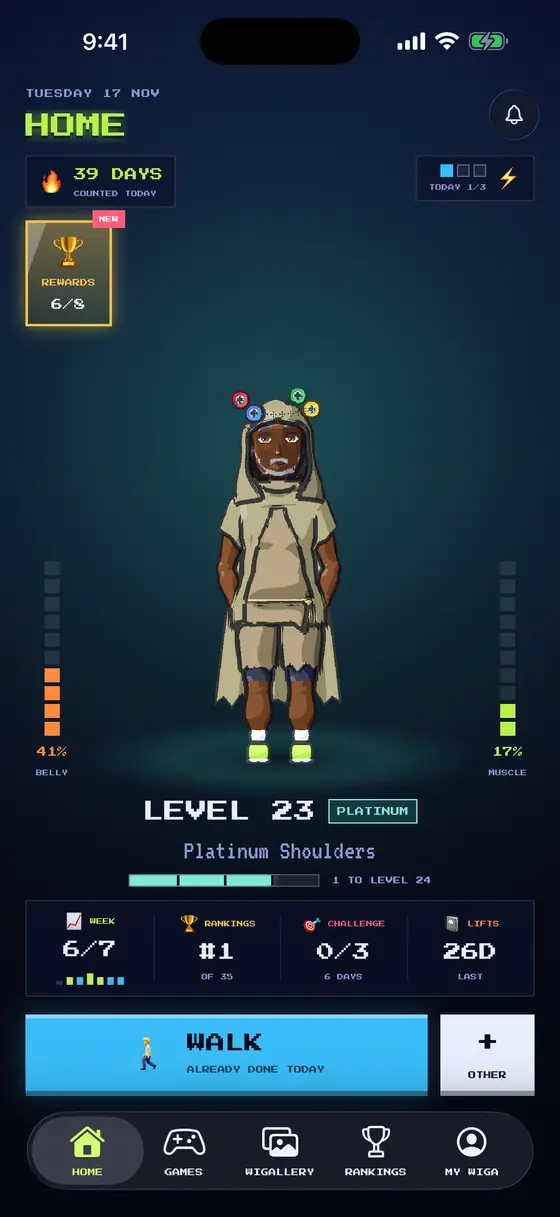
Gym Wigas is an app for iPhone and Android built around these ideas. It doesn't tell you which routine to do: it makes you want to turn up.
- Make progress visible
- You create a character, your wiga, that starts out with a bit of a belly and gets hench over time. It goes up a level every 4 check-ins; there are 50.
- Make it really count
- Every gym visit is confirmed by your phone's location. There's no “trust me, I went” button.
- Let someone else know
- Your community sees every check-in, and you compete on weekly, monthly and all-time leaderboards.
- A plan for the bad day
- Runs, walks, rides, dancing and home workouts count too, and there are games you play with your body in front of the camera: press-ups, planks, boxing.
- Reward yourself today
- Streaks, levels, ranks and one-minute duels against your mates.
- No one-day heroics
- At most three sessions count per day: whoever turns up regularly wins, not whoever goes all out on a Sunday.
Who it's not for: there's no free version (£4.99 a month or £39.99 a year; the annual plan starts with a 7-day trial), and on Android it's still an invite-only beta.

A four-week plan
For starting from scratch. If you already train, step it up wherever it says “two”.
Week 1
Two short sessions, on fixed days at a fixed time. One goal only: turn up both times.
Week 2
The same two, plus a 20-minute walk on another day. Tell someone which days are yours.
Week 3
Three sessions. Settle on your minimum version for the bad day and use it once, on purpose.
Week 4
Three sessions and a challenge with a mate: who logs more days this week. When it's done, decide which days stay fixed.
For reference, the World Health Organization recommends at least 150 minutes of moderate-intensity activity a week for adults. You don't need to hit that in month one: habit first, volume later.
Frequently asked questions
How long does it take to build an exercise habit?
It depends on the person. In the most cited study on habits, it took between 18 and 254 days. What speeds it up is repeating in the same context: same days, same time, same place.
What should I do if I've missed a whole week?
Come back with the small version: one short session, today or tomorrow. Don't make up for it with a double session; what you want back is the habit of turning up.
Is it better to work out in the morning or the evening?
The best time is the one you can repeat. If your mornings are chaos, don't build your habit on them.
Do apps help you stay consistent?
The ones that give you a reason to come back do: progress you can see, a streak, people who notice when you skip. An app that only measures doesn't change what you do; one that makes you want to turn up does.
Can I build the habit working out at home?
Yes. The same rules apply: a fixed time, a spot that's ready and something keeping count. At home the challenge is that nobody sees you, so find someone to compete with or report to.
Sources
- Lally, P., van Jaarsveld, C. H. M., Potts, H. W. W., & Wardle, J. (2010). How are habits formed: Modelling habit formation in the real world. European Journal of Social Psychology, 40(6), 998–1009. doi.org/10.1002/ejsp.674
- World Health Organization (2020). WHO guidelines on physical activity and sedentary behaviour. www.who.int/publications/i/item/9789240015128
This guide is general information, not medical advice. If you have an injury or a health condition, check with your GP or another professional before you start.
Start small. Start today.
Your wiga starts out with a bit of a belly too.